

Development land in Austin: value, buyers, and off-market sourcing
If you own raw acreage in the Austin MSA and want to know what it's worth and how to sell it to a developer, this page answers the core questions — with the current numbers and the way a commercial agent actually approaches it.
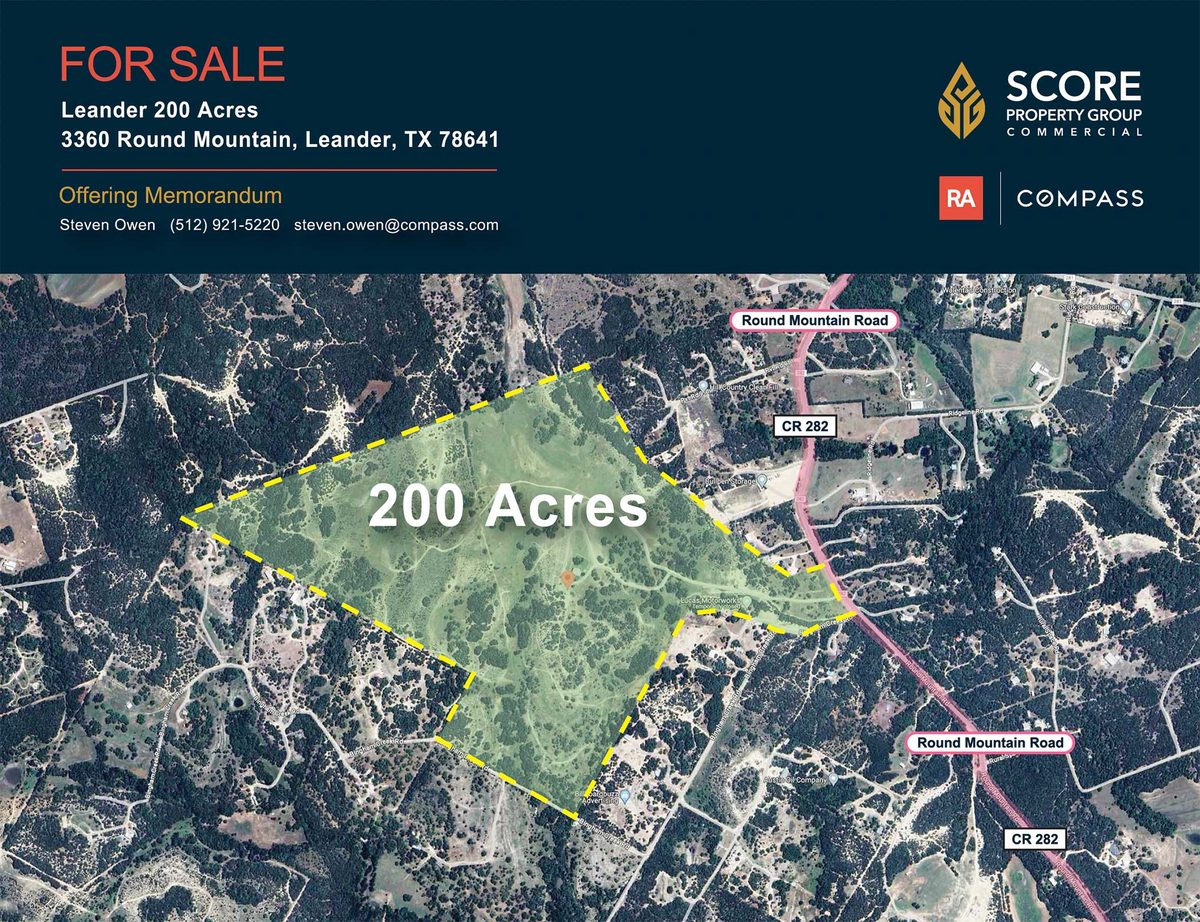
Example: ~200-acre development tract at 3360 Round Mtn, Leander — a current SCORE Property Group listing.
On this page
How much is my development land worth in Austin?
Development land in Austin is worth what its highest and best use can support after entitlement — not what comparable raw acreage recently sold for. Inside Austin city limits, developable land commonly runs from about $300,000 to over $1,000,000 per acre, reaching $1.5M–$2M per acre in premium areas like Westlake and far less for rural Hill Country tracts.
The number that matters is set by a residual land analysis, not a comp average. The method: project the finished value of what can be built at the site's zoning and density, subtract hard construction costs, soft costs, financing, and the developer's required profit margin, and whatever's left is the maximum supportable land price. Two adjacent tracts can differ in value by an order of magnitude based on zoning, utility access, and impervious-cover limits.
| Location type | Typical price / acre |
|---|---|
| Premium infill (Westlake, Tarrytown) | $1.5M–$2M+ |
| Inside city limits, developable | $300K–$1M+ |
| South / far West Austin (emerging) | $500K–$800K |
| Suburban (Lakeway, Dripping Springs) | $300K–$500K |
| Rural Hill Country (raw, large tract) | ~$7,700 avg (regional) |
Ranges are directional and move with interest rates, entitlement risk, and submarket demand. A site-specific residual analysis is the only way to price your tract accurately. Ask us for a no-obligation land valuation.
How do I sell raw land to a developer in Austin?
Sell raw land to a developer by leading with what can be built, not the dirt itself. Establish highest and best use, price it with a residual model, package the vision (site plan, demographics, pro forma) in an offering memorandum, market it both directly to active developers and broadly on CoStar/LoopNet and Crexi, then structure terms that protect you through the buyer's feasibility period.
The sequence we run:
- Highest-and-best-use study — zoning, utility capacity, jurisdiction (city limits vs. ETJ vs. county), and entitlement path.
- Residual pricing — back into the maximum a developer can pay and still hit their return, then set a list strategy against it.
- Offering memorandum — professional photography, drone, site concepts, demographic trends, and a pro forma so a buyer can underwrite without visiting.
- Targeted + broad marketing — direct outreach to a private network of 1,700+ developers and investors, plus national exposure on CoStar/LoopNet and Crexi.
- Deal structuring — feasibility period length, extension fees, earnest-money escalation, and closing conditions calibrated to protect the seller while keeping competitive tension.
What do developers look for when buying land for multifamily?
Multifamily developers buy land that supports the density they need at a basis where the project still pencils. The screen: zoning or a clear entitlement path for the target units per acre, wet and dry utility capacity at the site, access and traffic, manageable floodplain/topography/tree constraints, proximity to jobs and retail, and submarket rent demand.
In Austin specifically, the make-or-break items are wastewater capacity, impervious-cover limits, and entitlement timeline. A tract that looks cheap per acre can be unbuildable — or carry years of entitlement risk — if utilities aren't there or density isn't approvable. Positioning a site for multifamily means proving the density and the path to it before a developer ever underwrites.
Where are the best development sites in the Austin area?
The strongest Austin-area development corridors follow the highways and job growth: the I-35 and SH-130 spines (Round Rock, Pflugerville, Georgetown, Hutto, Kyle, Buda, San Marcos), the US-290 and SH-71 corridors, and the US-183 tech corridor. The "best" site is use-specific — multifamily wants jobs and density approvals, industrial wants highway access and large flat tracts, retail wants rooftops and traffic.
The highest-value plays are usually sites positioned ahead of announced infrastructure (highway expansions, utility extensions) and major employer moves. That's where a future-vision marketing approach — showing the planned value-generators around a tract — converts raw land into a competitive, multiple-offer sale.
How do developers find off-market land in Central Texas?
Off-market land in Central Texas trades through agent relationships and direct-to-owner outreach, not public listings. Active agents circulate opportunities within a private network of developers, investors, and landowners before anything lists; other channels include appraisal-district ownership research, title/entity skip-tracing, and pocket listings shared agent-to-agent.
If you're a buyer, the reliable way in is an agent with a curated, active rolodex. If you're an owner, that same network is how your tract gets in front of the right developers quietly and competitively. Our buyer-and-seller network spans Austin, Houston, Dallas, California, and New York.
We currently hold off-market pocket listings with US-290 frontage on the corridor between Austin and Dripping Springs — tracts of approximately 56, 53, 30, and 10 acres (the 56- and 53-acre sites are currently under contract) — available to qualified buyers only. See our listings or inquire.
Want to know what your Austin land is worth?
We'll run a highest-and-best-use and residual land analysis on your tract — no obligation.
Request a land valuationSources
- J. Angelo Design Build — How Much Does an Acre of Land Cost in Austin, Texas (2026)
- CKN Homes — How Much Does Land Cost in Austin, Texas (2026)
- Texas Farm Credit — Texas Land Pricing Guide 2026